Georgina RannardScience reporter
Four astronauts evacuated from the International Space Station (ISS) have landed back on Earth after their stay in space was cut short by a month due to a “serious” medical issue.
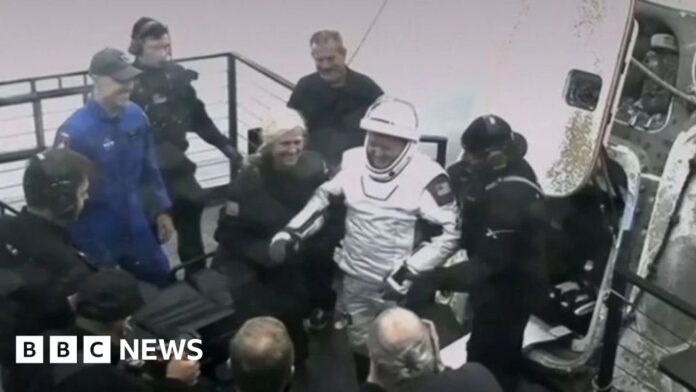
The crew’s captain, Nasa astronaut Mike Fincke, exited the spacecraft first, smiling and wobbling slightly on his feet before lying down on a gurney, following normal procedures.
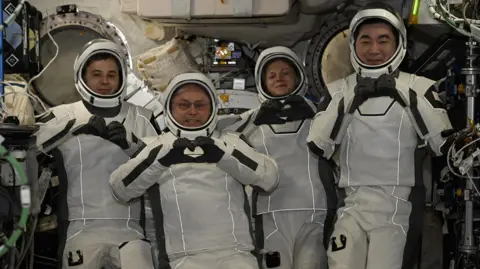
Nasa’s Zena Cardman, Japan’s Kimiya Yui and cosmonaut Oleg Platonov followed, waving and beaming at cameras. “It’s so good to be home!”, said Cardman.
It is the first time astronauts have been evacuated due to a health issue since the station was put into Earth’s orbit in 1998.
The team, known as Crew-11, will now receive medical checks before being flown back to land after the splash down off the coast of California.
In a news conference after splash-down, Nasa administrator Jared Isaacman said the sick astronaut is “fine right now” and in “good spirits”.
Judging by past Nasa communications about astronauts’ health, it is unlikely that the identity of the crew member or details of the health issue will be released to the public.
Control of the ISS has been handed over to Russian cosmonaut Sergey Kud-Sverchkov and two other crew members.
The astronauts arrived on the ISS on 1 August expecting to complete a standard six and a half month stay. They were due to come home in mid-February.
ut last week, a scheduled spacewalk by Fincke and Cardman was called off at the last minute. Hours later, Nasa revealed a crew member had become ill.
“It’s bittersweet,” said Mr Fincke when he handed over the keys to the ISS to Kud-Sverchjov on Monday.
In a social media post, he stressed that all crew members on board were “stable, safe, and well cared for”.
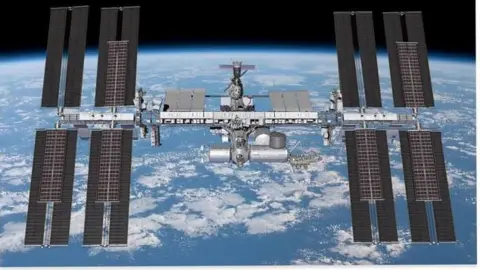
Orbiting Earth at an altitude of 250 miles, the International Space Station (ISS) makes 16 orbits of our planet a day, travelling at a speed of 17,500 miles per hour.
It is run by five space agencies and carries out wide-ranging scientific research about space and the effects on humans, animals and plants of living in microgravity.
 NASA
NASAThe ISS carries some medical equipment and astronauts are trained to deal with minor medical issues, but it does not have a doctor on board.
The evacuation was a serious test of Nasa’s procedures for dealing with medical issues.
By all accounts, it passed, although there may be questions about how well the agency could have responded if the astronaut had suffered a medical emergency.
The early departure leaves the ISS with a skeleton crew of just three astronauts – Nasa’s Chris Williams and cosmonauts Kud-Sverchkov and Sergei Mikaev – until another four arrive in February.
“Despite all the changes and all the difficulties, we are going to do our job onboard ISS, performing all the scientific tasks, maintenance tasks here, whatever happens,” Kud-Sverchkov said on Monday. He then issued his first command – a group hug.

 NASA
NASAThe incident is unprecedented in the history of the ISS, which has been permanently crewed for 26 years.
Space missions have ended early due to health issues just twice before.
In 1985, Soviet cosmonaut Vladimir Vasyutin and his colleagues returned four months ahead of schedule from a mission to the Salyut 7 space station due to a urological issue.
And in 1987, a heart arrhythmia caused Soviet cosmonaut Aleksandr Laveykin to leave the Mir space station early.
As more and more humans travel into space, including for tourism and a possible occupation of the Moon or even Mars, space experts say doctors will need to travel on missions.